Taking the Future Lightly
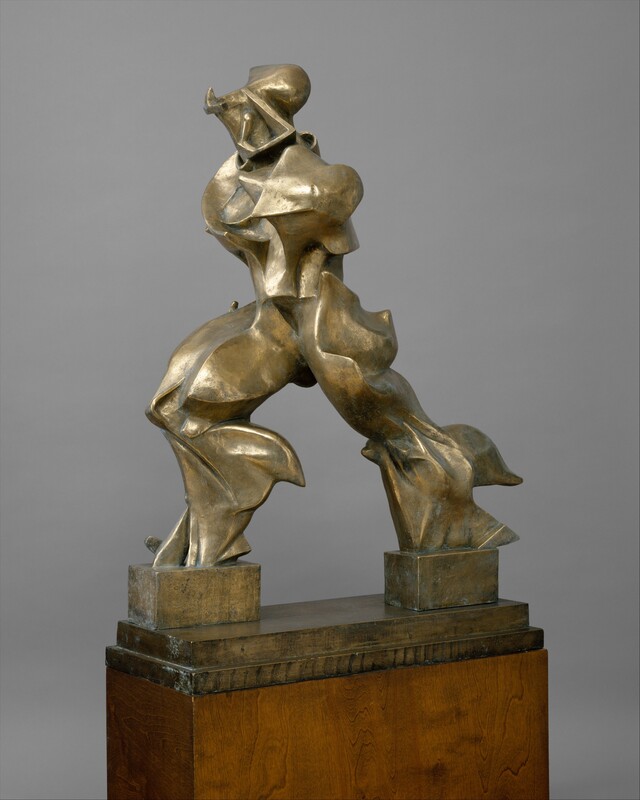
In 1909, Filippo Tommaso Marinetti published the Futurist Manifesto in Le Figaro, and it opens (this is not incidental) with a car crash. Marinetti and his friends are speeding through Milan at night, swerving to avoid cyclists, and they flip the car into a ditch, and he crawls out covered in factory mud and declares it baptismal, and then he sits down and writes eleven theses whose collective argument is basically that speed is holy, the past is a corpse, the museums should burn, and the only beauty worth having is the beauty of struggle. “A roaring motor car,” he writes, “is more beautiful than the Victory of Samothrace.” The Futurists worshipped the future the way mystics worship God, as the source of all meaning, the only direction worth facing, and they wanted to destroy everything old and merge with the machine, and Marinetti later wrote an actual manifesto against pasta, because he was, to put it gently, a man of commitments, but the impulse underneath the absurdity was real. Technological acceleration was producing a new kind of consciousness, and the Futurists believed the appropriate response was ecstasy. He ended up a fascist. That's where the posture terminates. That's what happens when you try to drag the future into the present so violently that the past shatters on impact.
I bring Marinetti up because I've been thinking about Citrini, and because the particular flavor of ecstasy Marinetti was after, the collapse of temporal distance, the violent merging of what-is-coming with what-is, turns out to be the same move, structurally, as something described in a text that predates him by roughly two thousand years. But before I get to that I need to talk about a word. There is a word in Ge'ez, the liturgical language of the Ethiopian Orthodox Tewahedo Church, that I have been turning over for months, and the word is ተስፋ, tesfa, and it gets rendered in English as “hope,” and the translation is not wrong exactly but it is catastrophically incomplete. ተስፋ carries in its Semitic root something closer to patient expectation structured by trust, an orientation toward the future that does not require you to see it clearly, or to seize it, or to flee it, but to walk toward it with your weight planted on the present step. It is not optimism, which is a prediction. It is not hope in the thin modern sense of “I hope it doesn't rain.” It is architectonic, a way of being in time, and I think it is the thing the current moment most desperately needs and most completely lacks, and I want to try to explain why, though the explaining is going to require some patience because I need to route through angels and economists and a senior devil writing letters to a junior devil, and I realize that sounds like I'm stalling but I promise all of these are load-bearing.
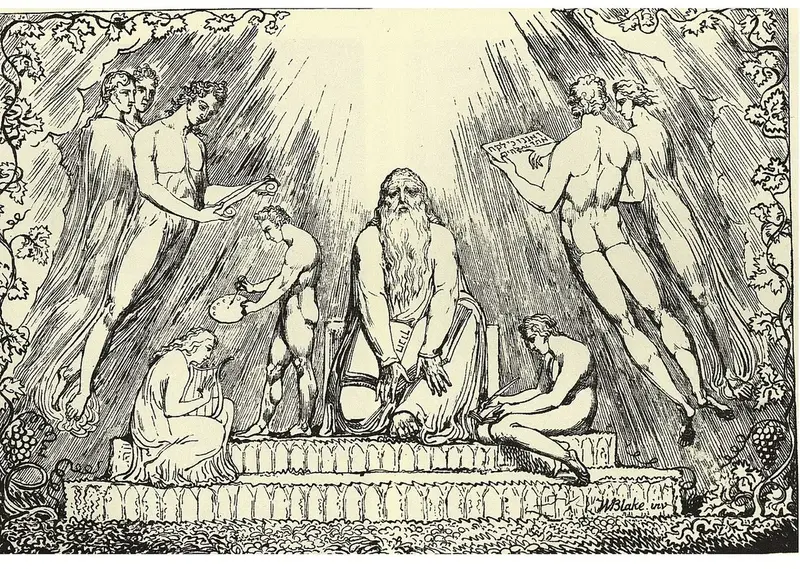
The Book of Enoch, the መጽሐፈ ሔኖክ, is a text the Ethiopian Orthodox Tewahedo Church has held canonical for sixteen centuries while the rest of Christendom let it drift into apocrypha, and whose central narrative, when you strip it to its architecture, is about what happens when knowledge arrives before its time. In chapters 6 through 16, a group of angels called the Watchers, the egrēgoroi, literally “the wakeful ones,” descend to Mount Hermon and teach humanity things that humanity was not supposed to know yet. Azazel teaches metalwork and weaponry and cosmetics. Semjâzâ teaches enchantments and root-cutting. Barâqîjâl teaches astrology. And the consequence of this premature revelation is not enlightenment but catastrophe. The knowledge fills the world with ደም, with blood, and with ጩወት, with outcry and lamentation, not because the knowledge is false but because it arrives in a context that cannot hold it, the way a vessel shatters under a pressure it was not designed for. And here is the thing I want you to notice, because it is the hinge that the rest of this essay turns on: the Watchers' sin is not that they know things (they are angels, knowing things is presumably their whole deal) but that they drag a future knowing into a present that hasn't earned it, and the present ruptures under the weight.
The Ethiopian Orthodox liturgical tradition has a concept rooted in Enoch and in the broader Ge'ez theological vocabulary, ጊዜ, which is time, but not time the way we tend to think of time in the post-industrial West, as a quantitative succession of empty identical moments waiting to be filled, like jars on a shelf. ጊዜ is time with a qualitative structure, each season possessing its own character and its own appropriate revelations, so that the temporal order is not an arbitrary constraint you could rearrange without consequence but a structural feature of reality itself, and to violate it is to produce not wisdom but a kind of spiritual desolation that looks from the outside like knowledge but is actually its counterfeit. This is why the Watchers are punished not for the content of what they reveal but for the timing. They unseal what was sealed. They bring the eschaton forward. They are bound in the valleys of the earth until the day of judgment. Marinetti, who wanted to drag the future into the present so violently that the past would shatter on impact, was essentially proposing to be Azazel at industrial scale. He just didn't have the Ge'ez for it.
I bring all of this up because of Citrini.
Last month, Citrini Research published “The 2028 Global Intelligence Crisis,” a speculative dispatch written as if from June 2028, and in this scenario AI agents have replaced software engineers and middle managers, the S&P has crashed 38%, unemployment has crossed 10%, and the mechanism is a feedback loop they call a “human intelligence displacement spiral” in which companies lay off workers, reinvest savings into compute, the compute enables more layoffs, and real purchasing power collapses with no natural brake. Twenty-two million views on X. Software stocks fell as people read it. The market moved on what I can only call a thought experiment, a piece of speculative fiction so vivid and internally coherent that it briefly altered the territory it was mapping. You read it at 2am and feel your career dissolving beneath you and the feeling is so physiologically precise, so located in the chest and the jaw, that you forget you are responding to a story.
The rebuttals came quickly and they are, I think, largely correct. Citadel pointed to actual job posting data and the St. Louis Fed's finding that daily AI use for work presents little evidence of imminent displacement risk. Noah Smith pointed out that Citrini uses no explicit macroeconomic model, which makes it impossible to identify the transmission mechanism in formal terms. Multiple commentators invoked the historical pattern: flash-frozen food took farming from 30-40% of American employment down to 2-5%, and by the logic of Citrini's displacement spiral this should have produced a permanent depression, but instead the economy reallocated into sectors the farmers of 1910 could not have imagined. The consensus among professional economists, insofar as one exists, is that projection systematically underestimates adaptation and the apocalypse will be deferred. I find the rebuttals persuasive and I think most reasonable people did too.
And yet. Twenty-two million people read it, and the market moved, and the rebuttals did not settle anything emotionally, and the reason is that Citrini was doing something the rebuttals could not address because it was not the kind of thing that rebuttals address. Citrini collapsed 2028 into 2026. Made you feel an unemployment rate that has no existence yet as a physical sensation in your chest while you sat in your apartment with a job and a paycheck and people who love you. Took a future that might or might not arrive and compressed it into present-tense dread so total that you mistook it for analysis. And this is, when you strip it to its structure, the sin of Azazel. It is the Watcher move. Dread instead of ecstasy, but the same temporal violation, the same dragging of a future knowing into a present that hasn't earned it, the same rupture.
I want to be careful here because I am not saying Citrini is wrong in the way that Citadel says Citrini is wrong (though I think Citadel's points about physical constraints on compute and the elasticity of human wants are well taken). I am saying something different and the difference matters. The genre of thing Citrini did, the temporal collapse, the conjuring of a future so vivid you experience it as present, is the thing the Enochic tradition identifies as the fundamental mechanism of spiritual destruction, and this is true whether the future you're conjuring turns out to be accurate or not. The damage is not in the prediction. The damage is in the habitation. You have left the room you're sitting in and gone to live in a room that hasn't been built yet, and the move happened so smoothly, so dressed up in data and scenario-modeling and the aesthetics of rigor, that you mistook it for responsibility.
This is also the exact opposite of ተስፋ.
There is a spectrum here worth mapping. On one end you have ecstatic futurism, the Marinetti move, the orientation that says the future is the only thing that matters and we should rush toward it, merge with it, let it annihilate the present. In the current discourse this maps onto a certain species of techno-optimist who treats acceleration as its own justification and would, if you pressed them hard enough and they were being honest, happily be Azazel at industrial scale. On the other end you have dread futurism, which is the Citrini move, the 3am doom-scroll, the elaborate scenario-building that is really (and I say this with genuine sympathy, because I have been there, everyone I know has been there) just anxiety wearing the costume of analysis. And the thing the Enochic framework makes visible in a way that no other framework I've encountered quite does is that these two orientations are not opposites. They are the same move. In both cases you have left the present. In both cases the future has become the only place where meaning lives. The ecstatic futurist and the doomer are structurally identical because they have both violated ጊዜ, the qualitative order of time, by collapsing a future disclosure into a present that cannot metabolize it.
ተስፋ is neither of these. And this is the part that is hardest to articulate, partly because English doesn't have the architecture for it and partly because modern Western culture doesn't have the practice of it, or at least not a practice that hasn't been thinned into greeting-card sentimentality or repackaged as “mindfulness” and sold back to you at $14.99/month as a productivity hack, which is (and I realize this is a digression but I think it's a necessary one) its own kind of Watcher-sin, the unsealing of a contemplative tradition developed over millennia and its compression into an app that promises you'll be 23% more focused in meetings.
Here is what ተስፋ actually is, as a lived posture rather than a theological abstraction.
ተስፋ is the practice of going to the future, taking what is useful, and coming back. It is the discipline of the return. You can think about AI displacement, you can read the Citrini essay, you can study the labor data and the macro models and the historical analogies, and all of this is fine, all of this is what Lewis calls prudence and what the Ethiopian tradition understands as the appropriate use of ትንቢት, prophetic foresight directed toward present action. The general studies the map before the battle; this is good. But ተስፋ means you come back. You take what is actionable and you leave the rest. You refuse to move in. The distinction is not about the content of the thought but about whether the thinking returns you to present action or removes you from it. If it moves you to send the email, learn the skill, make the plan, have the conversation, it is serving its purpose. If it paralyzes you, if it sends you into the 3am spirals, if it makes the actual world go grey while the imagined one sharpens into unbearable clarity, then you have crossed from prudence into habitation, and you are paying rent in the devil's country for the privilege of living somewhere that doesn't exist.
I use the phrase “the devil's country” deliberately, because C.S. Lewis arrives at almost exactly the same structural insight from a completely different direction. In Letter 15 of The Screwtape Letters, Lewis writes from the perspective of a senior devil advising his apprentice on how to corrupt a human soul, and the strategy is simply this: fix the patient's attention on the future. Not because the future is evil (Lewis is very precise here) but because the future is where anxiety lives. Nearly all vices are future-oriented. Fear is about what might happen. Avarice is about what you might lose. Ambition is about what you might become. Even lust is less about present pleasure than about the anticipated repetition of it. The present, by contrast, is where love happens, where gratitude is possible, where actual work gets done, and the devils' entire project is to get you out of it. God, in Lewis's framework, wants humans attending to eternity and the present; the devils want them everywhere else, which is to say, in the future, which is to say, in the place that does not exist, which is to say (and this is where Lewis and the Enochic tradition shake hands across two thousand years), in the exact room Citrini moved twenty-two million people into at 2am on a Tuesday.

Lewis wrote an essay during the Second World War called “Learning in War-Time,” addressing Oxford students who were wondering whether it made sense to study literature and philosophy while bombs were falling, and his argument was that the war created no new situation, that it revealed an old one. Humans have always lived on the edge of uncertainty. Every career was always contingent. Every skill was always temporarily valuable. Every plan was always subject to revision by forces beyond the planner's control. The peacetime sense of security was always an illusion, and bombs just strip it away. AI strips it away in exactly the same manner, and the question was never “how do I secure my future” because the future was never securable. The question was always “how do I live well in the present given that the ground is moving.”
I know the objection. It sounds like passivity, like sticking your head in the sand while the world reorganizes around you. And I will grant that people will lose jobs they expected to keep, and the disruption will be unevenly distributed, and some of the people it hits will have done everything right and it won't matter. But the generation that fears AI displacement is experiencing, in concentrated form, the same vertigo that every generation has experienced when the world changed beneath them: the weavers facing the power loom, the farmers facing mechanization, the telephone operators facing the automatic switchboard. And in each case the catastrophic predictions were wrong, not because the disruption wasn't real but because the human capacity to adapt, to redeploy, to create new forms of value, and to want new things, consistently exceeded what anyone could project from inside the moment of disruption. The future always arrives looking like none of what anyone projected, because the world is more stubborn and more inventive than any scenario can capture, and the mapmaker is always inside the territory, changing it by the act of mapping.
There is a passage in 1 Enoch 104 where the righteous are told to be hopeful and cast not away their hope, and the word is ተስፋ, and the passage functions not as reassurance, not as “chin up,” but as instruction, as a direct claim about the posture of consciousness that makes it possible to move through a world whose future is illegible without either seizing the future in ecstasy or collapsing under it in dread. The verse I keep returning to, that Lewis circles around in different ways across everything he wrote, is from Lamentations: “His mercies are new every morning.” The Ge'ez, as it appears in the Ethiopian liturgical tradition, ምህረቱ በየጥዋቱ አዲስ ነው, carries this sense of daily renewal as structural, as cosmological, not merely as a nice devotional thought but as a claim about the actual architecture of time. You get today's grace today. Tomorrow's arrives tomorrow. You are provisioned for the step you're on.
Citrini collapsed 2028 into 2026, made you feel an unemployment rate that has no existence yet as a physical sensation in your chest while you sat in your apartment with a job and a paycheck and people who love you, and Lewis would call this diabolical imagination, and the Ethiopian fathers would call it the sin of Azazel, and they would both say, gently, firmly, with the authority of traditions that have metabolized more upheaval than the AI discourse can presently imagine, that you have been robbed. Your attention has left the room it's sitting in and gone to live in a room that hasn't been built yet, and the robbery happened so smoothly, so dressed in the aesthetics of analysis, that you mistook it for responsibility.
So notice what happens when you think about the future. Just notice. Notice whether the thinking brings you back or takes you away. Notice whether you return from the future with something you can use or whether you stay there, furnishing the rooms. The correction is not to stop thinking about the future. The correction is to come back. To recognize that the ground was always moving and we were always walking on it anyway, and that the people who built lives worth living in every previous era of upheaval did so not by mapping the future but by attending to what was in front of them, the next conversation, the next piece of work, the next person who needed something, with the full weight of their attention, trusting, in the ተስፋ sense, that the future would arrive with its own provisions when it arrived.
The future will come and it will look like none of what any of us projected, because it never does, because the world is more stubborn and more inventive and more weird than any of our scenarios, and the mapmaker is always inside the territory, changing it by the act of mapping. In the meantime there is the work in front of you and the people around you, and both are worth your full attention.
ተስፋ ይኑርህ።
Take the future lightly. Take the next step.